
JANE2 project’s Survivorship Network of Expertise second meeting in Barcelona strengthens European collaboration on cancer survivorship care
On May 7 and 8, the JANE2 Survivorship Network of Expertise (NoE) convened its second in-person meeting in Barcelona, bringing together experts, clinicians, researchers, patient representatives, and institutional partners from across Europe to advance collaboration on cancer survivorship care.
Hosted by the SJD Barcelona Children’s Hospital (HSJD), the two-day event gathered 55 participants from 13 European countries. The meeting aimed to strengthen coordination across NoE's partners and support the development of a more integrated and sustainable survivorship care framework across Europe.
Day 1 focused on strategic alignment among the NoE's task leaders. Through a series of topic sessions, participants reviewed progress, identified major challenges, discussed potential solutions, and defined next steps across Tasks 7.1 to 7.6. Key topics included governance of the Survivorship NoE, landscape analysis of survivorship care in Europe, development of integrative survivorship care programmes, implementation strategies, capacity-building activities, and evaluation frameworks.
Day 2 broadened participation to a wider group of contributors and focused on collaborative reflection and practical problem-solving through interactive breakout sessions. Participants were organised into small discussion groups according to their involvement in specific tasks, facilitating dynamic exchanges and active participation.
The breakout sessions were designed to generate structured and actionable feedback to support the refinement of each task. Discussions explored topics such as the future role and services of the NoE, feasibility of integrated survivorship care pathways, practical educational strategies for healthcare professionals, implementation challenges across healthcare systems, and realistic care evaluation approaches adaptable to different European settings.
Participants worked collaboratively to identify key priorities, highlight critical challenges, propose potential solutions, and raise open questions for future development.
The meeting reinforced the shared commitment among European partners to strengthen survivorship care through collaboration, knowledge exchange, and the development of practical, patient-centered approaches that can be adapted across diverse healthcare systems.
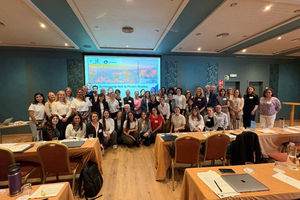
The breakout sessions were designed to generate structured and actionable feedback to support the refinement of each task.
