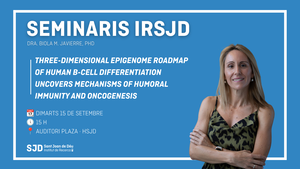
Three-Dimensional Epigenome Roadmap of Human B-cell Differentiation Uncovers Mechanisms of Humoral Immunity and Oncogenesis
IRSJD September Scientific Seminar: "Three-Dimensional Epigenome Roadmap of Human B-cell Differentiation Uncovers Mechanisms of Humoral Immunity and Oncogenesis". Dr. Biola M. Javierre, PhD from Josep Carreras Leukaemia Research Institute (IJC). Host: Dr. Sandra Castillo, Tumors and vascular malformations.
Abstract
Human B-cell differentiation underlies humoral immunity, and its disruption leads to cancer, autoimmunity, and immunodeficiencies. However, the enhancer-based regulatory mechanisms governing this process remain poorly understood. To address this gap, we generated the first three-dimensional epigenomic roadmap of human B-cell differentiation in vivo. By profiling nine differentiation stages, we linked nearly half a million enhancers to their target genes through chromatin interactions, defined their activity states, and predicted bound transcription factors. We show that the acquisition of B-cell identity, distinct from common cellular processes, relies on large enhancer networks acting additively and synergistically to finely tune transcription. We further identify a 3D epigenetic priming mechanism underlying immune memory, whereby memory B cells retain primed DNA loops that enable faster responses upon antigen re-exposure.
Informació sobre la ponent
Since establishing her independent research group in 2019, following two maternity leaves, Dr. Javierre has built a multidisciplinary research programme integrating expertise in cell differentiation, cancer biology, epigenetics, and three-dimensional genome organization to uncover the regulatory mechanisms governing normal and malignant haematopoiesis. Her laboratory, based at the Josep Carreras Leukaemia Research Institute
Dr. Javierre has built a strong international scientific network and demonstrated outstanding leadership, earning recognition as one of the most promising young investigators in her field. Her achievements have been acknowledged through prestigious awards, including the L'Oréal-UNESCO For Women in Science Research Award (2018), the L'Oréal-UNESCO International Rising Talents Award (2019), the PharmaMar Foundation Young Investigator Award (2024), and the Scientific Talent Award from the Spanish Royal Academy of Sciences (2025).